The short answer: before the target becomes a commitment. A growth number already contains assumptions about customers, demand, timing and investment. Marketing can help test those assumptions while there is still room to change the plan, instead of inheriting the number and working backward to explain it.
I have been asked to generate more leads without anyone being able to explain where the higher target came from.
The explanation I got was that the product was getting better. I understood the optimism. A better product should create more opportunity.
But I still needed the connection. What had changed for the customer? Were we removing a reason prospects had not bought? Giving existing customers a reason to buy more? Opening a market we could not serve before?
Those answers would decide what my team needed to do. They would also tell us whether more leads was the right expectation at all.
That experience is why I believe marketing belongs in the conversation while the plan is being built, not after the number is set.
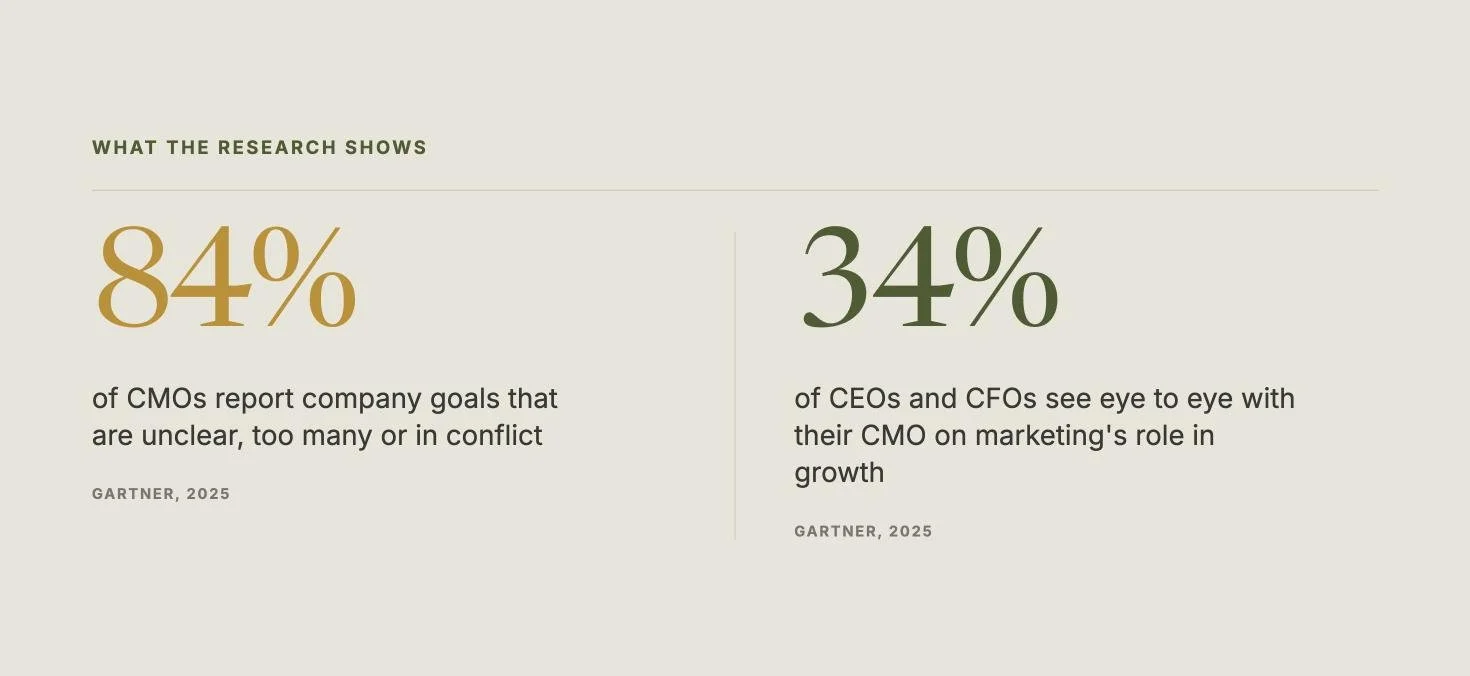
It is also more common than it should be. When Gartner surveyed 403 CMOs, 84% described what it calls strategic dysfunction: company goals that are unclear, too numerous or in conflict. Leadership sees the gap too. In a separate Gartner survey, only about a third of CEOs and CFOs said they see eye to eye with their CMO on marketing's role in growth.
Neither number describes a marketing problem on its own. Both point to the same question: who is in the room while the plan takes shape.
Start with how growth is supposed to happen
A product improvement can drive growth in several ways:
It can remove an objection and help Sales win more of the deals already in the pipeline.
It can give current customers a reason to add another product.
It can improve adoption or retention.
It can make a new group of buyers a better fit.
Each outcome has value. Each calls for a different plan.
If growth is supposed to come from better conversion, I want to know where deals stall and what would help them move. If it is expansion, I want to know which customers actually have the need. If it is new demand, we need to define the audience, why it should care and how we will reach it.
Raising the lead target does not answer those questions. It moves them to the team with the least context.
In PropTech, this comes up all the time. A new capability in a property management platform may mean little to an operator who has never heard of the company. It may mean a great deal to a current customer who has been asking for it. Those are different campaigns, with different owners and different measures of success.
I want marketing to help answer those questions, and I want the answers to reflect what Sales, Product and Customer Success know. No single team has the full picture.
Treat a request as the visible end of a bigger decision
The same pattern shows up in account-based marketing.
Marketing often gets pulled in when someone needs a gift, a custom deck or materials for a meeting. We can help with those things. Understanding the account gives us a better chance of recommending something that actually moves the deal forward.
Before I build anything, I want to know:
Who is involved in the decision?
What is the customer trying to accomplish?
What concerns are still unresolved?
What needs to happen next?
That context matters more as more people weigh in. Forrester's 2024 buying research found that an average of 13 people are involved in a B2B purchase decision. A gift for one of them rarely settles the questions the other twelve still have.
With that context, the right action might be the requested deck. It might also be customer proof that answers an objection, or content for someone in the buying group who has not engaged yet. The goal is enough shared planning that marketing can contribute judgment, rather than reconstruct the strategy from a list of requests.
Decide what gives when priorities change
Plans change. A customer opportunity emerges, a launch moves or leadership learns something new. The business should respond.
But every new priority raises a question about the existing ones. Does another project move? Does the scope get smaller? Do we add resources? Do we accept a different timeline or outcome?
Those choices get made whether anyone says them out loud or not. Left unspoken, the team makes them through interrupted work, delayed projects and stretched capacity.
Marketing should make the impact visible and recommend options. I use a simple sentence to do that: "To add this by that date, we would need to change this existing work. My recommendation is this option, because of this reason. The decision we need is this." It turns a renegotiation into a decision someone can own.
Plan for what happens after someone engages
Broader solution messaging can be very effective. It also creates a handoff question that teams need to plan for.
Someone might engage because they recognize a business problem without knowing which product they need. That can be the start of a useful conversation. Sales needs to know what prompted the engagement, explore the underlying need and record what it learns.
If Marketing plans for that kind of engagement while Sales expects every lead to arrive asking for a specific demo, the lead-quality debate is already on the calendar. Agree up front on what qualifies someone for follow-up, what context travels with them, who follows up and how quickly, and how the response will be evaluated. For multifamily teams, timing is where good interest most often goes cold. I covered that in why multifamily lead management breaks down as a portfolio grows.
The customer experiences the whole process. The plan should account for all of it.
From the field: "We need a campaign" is one of the most common requests marketing hears. These are the same questions I use to turn that request into a plan the business can act on, and sometimes into something better than a campaign. See how I'm applying this in go-to-market planning.
Read missing context as information
When marketing is brought in late, I do not assume no planning happened.
Sometimes the planning is incomplete. The business knows the outcome it wants, but the audience, investment, ownership or timing still need to be worked through.
Sometimes the reasoning exists but has not traveled well. Product understands the problem being solved. Sales understands the account opportunity. Leadership understands the assumptions behind the forecast. Marketing receives a target without any of that context.
Usually it is some of both. The useful response is to name the gap:
What has been decided?
What supports the decision?
What still needs an answer?
Who needs to be involved?
Those questions separate a communication issue from an unresolved business decision. Either way, they give the team a practical next step.
Bring something to the table
Earlier involvement comes with responsibility.
Marketing should bring customer insight, performance data, a realistic view of channels and capacity, and a recommendation about where to focus. We should be willing to test assumptions, including our own. That includes being clear about which pipeline metrics to track and which to report, so the conversation stays on decisions rather than definitions.
If I recommend fewer campaigns, I owe the team an explanation of where that focus should help. If we change how engagement is qualified, Sales needs to understand what changes for them. If we propose more custom account work, we need to be clear about the investment and what it displaces.
Accountability for business outcomes is the right standard for a marketing team. It works when marketing has access to the decisions, context and partners that shape those outcomes.
At StayGold Growth, this is often where I start, whether the engagement is fractional marketing leadership or focused help with a single decision: connecting a growth target to the audience, the work and the people responsible, and making the open decisions visible before anyone commits budget. It is the same approach I describe in how experienced marketing leadership helps you make better decisions.
Try it with your own team
If you are working through a growth target right now, this is the worksheet I use. It takes your team from the number to the audience, the investment and who owns what.
Frequently asked questions
When should marketing be involved in business planning?
While growth targets are being set, before they become commitments. That is when marketing can still help test assumptions about the audience, demand, timing and investment behind the number.
What are the signs that marketing is being brought in too late?
Targets arrive without an explanation of where they came from, requests show up without account context, and new priorities get added without anyone deciding what moves. Each one means marketing is reconstructing reasoning that should have been shared.
Is "more leads" a good growth target?
Only once it is defined. New prospects, customer responses, qualified conversations and opportunities are different measures. The right one depends on whether growth is expected to come from new customers, better conversion, expansion or retention.
What should marketing bring to a planning conversation?
Customer insight, performance data, a realistic view of channels and team capacity, and a recommendation about where to focus. Marketing should also be clear about the trade-offs its own recommendations create.
How should a team handle new requests after a plan is agreed?
Name what the request would change, recommend an option and identify who needs to make the decision. Unspoken trade-offs still get made, usually through delayed work and stretched capacity.
Research referenced
Gartner, Gartner Survey Reveals 84% of CMOs Report High Levels of Strategic Dysfunction (2025)
Gartner, Only 45% of CMOs Surpass Senior Executive Expectations (2025)